KIGALI CITY TOUR.
INTRODUCTION
The City of Kigali has been the capital city of Rwanda since the 14th Century. It is geographically located in the heart of Rwanda. Over the last two decades, the City of Kigali has rapidly grown into a modern city and has not only become Rwanda’s most important business center but also its main port of entry.
Historically, Kigali was founded by King Cyirima I Rugwe (1345–1378) as the capital of Rwanda. In 1907, during the German colonization, Dr. Richard Kandt, the first colonial Resident of Rwanda, also chose Kigali as the Capital of Rwanda. In 1962 when Rwanda got its independence and in 1994 after the end of the Genocide against Tutsi, Kigali remained the capital city of Rwanda with three administrative districts: Gasabo, Kicukiro and Nyarugenge.
Kigali city is one of the safest, cleanest and friendliest of African capitals. It is blessed with a moderate high altitude climate that befits its tropical location, and is conveniently located within three hours’ drive of the main national parks (i.e. Volcanoes, Akagera, and Nyungwe and Gishwati Mukura national parks). The Rwandan capital offers the perfect vantage point to explore the rest of the Land of a Thousand Hills.
LANDMARK OF KIGALI CITY TOUR
1. Kigali Business Center (KBC): is a commercial building that has existed since 2003. It was the biggest shopping center around the Kacyiru, Kimihurura, Nyarutarama and Gishushu neighborhoods at the time.
In 2016, KBC went through a major facelift to match the beauty of the other surrounding buildings such as the Kigali Convention Center and Kigali Heights. Today, the building is a business complex with many stores that include banks, cafes, and shops among many others.
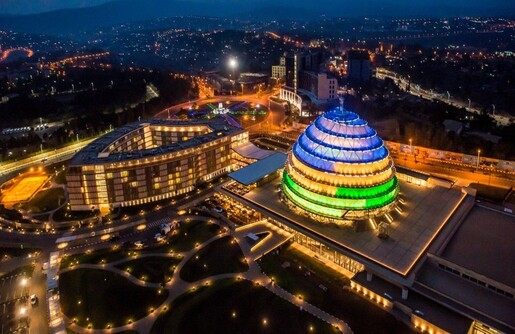
2. Kigali Convention Centre: The iconic Kigali Convention Centre is the premium events venue in Rwanda since its opening in 2016 and has grown into a hugely popular MICE destination in the region. Its multifaceted design reflects a traditional Rwandan homestead. The dome-shaped Main Auditorium, is symbolic of the Rwandan traditional hut in the King’s Palace and boasts a capacity to sit over 5,600 guests at once. The center also boasts cutting-edge technology, high speed internet, and world class audio-visual equipment.
3. Primature: The old Prime Minister’s Office is the oldest remaining high-rise building in Kigali located right across the KG1 Roundabout in Kimihurura Sector. It was constructed in 1972 by the first President of Rwanda, Grégoire Kayibanda and was meant to be the State House. It also served as the headquarters of former president, Juvenal Habyarimana’s National Republican Movement for Democracy and Development (MRND) ruling party in 1975 before becoming the Prime Minister’s Office from 1991 to 2019. The area it’s located is also home to other government institutions such as the Rwanda Revenue Authority (RRA), Ministry of Foreign Affairs and International
Cooperation, Ministry of Defense, and Ministry of Trade & Industry.
4. Saint Famille Parish: It is the oldest Catholic Church in Kigali. Constructed in 1913, the building is also one of the largest churches in the city. During the 1994 genocide against Tutsi, thousands of people took refuge in the church and many were massacred from there before the RPF (Rwanda Patriotic Front) soldiers carried out a rescue mission on the night of 16th -17th May 1994 that saved over 1000 lives.
5. The Kigali City Center: It is where several corporate offices, major banks, airline offices, tour operators and shopping galleries are located. Most known mixed use buildings in the area include the Makuza plaza, Pension plaza, Kigali City Tower, Centenary House and Kigali Investment Company (KIC) complex. These buildings host several fast-food outlets, boutique shops, banks as well as hotels and cafes with spacious terraced areas overlooking Kigali’s busy shopping streets.
6. Hotel des Mille Collines: It is one of the renowned 4-star hotels in Kigali. It became famous after 1,268 people took refuge in it during the 1994 Genocide against the Tutsi. The rescue operation at Hôtel des Mille Collines during the 1994 Genocide against the Tutsi was the result of diplomatic negotiations between the Rwanda Patriotic Army (RPA) and the then Rwandan Government facilitated by United Nations Assistance Mission for Rwanda (UNAMIR). The negotiations led to the exchange of pro-government leaders and civilians who were in Amahoro Stadium for the targeted civilians trapped at Hôtel des Milles Collines and, who up until the time of the rescue, were forced to pay to survive. The exchange took place at the main roundabout in Kimihurura and was supervised by UNAMIR. Those rescued by the RPA were transported to Kabuga. Featured in the popular “Hotel Rwanda movie”, the hotel was a UN Safe Zone during the genocide.
7. Camp Kigali Memorial: This place is home to the 10 stone columns representing 10 Belgian UNAMIR peacekeepers who were murdered on the first day of the 1994 Genocide against the Tutsi. Originally deployed to protect the home of the then Prime Minister Agathe Uwilingiyimana, the soldiers were captured, disarmed and brought here at the military barracks by the Presidential Guard and brutally murdered. The former military camp now hosts a memorial and small museum that still bears scars of grenade shrapnel. In the garden, ten stone obelisks were created; each pillar represents a life lost with the initials of one of the soldiers carved into the base and horizontal slashes indicating his age. Today, it’s also where the Kigali Conference & Exhibition Village (KCEV) is located to support the growing MICE (Meetings, Incentives, and Conferences & Events) tourism sector. The site is also host to various local art and craft
exhibitions where visitors can buy souvenirs from.
8. Mount Kigali: It is a sacred mountain where ancient Rwandans used to come and request their God the ‘Rwandan spirit’ (to remain Rwandan, not alienated). It is for this reason many Rwandan Kings came to live there and their royal cottages (ibigabiro) are still visible to date. Like the Statue of Liberty for Americans or Mount Sion for the Jews, Mount Kigali is the symbol of the “Heart of Rwanda” (where the “Heart of Rwanda Museum” will be built). King Cyirima I Rugwe named Kigali as the country’s capital in the 14th century. Mount Kigali is the highest peak (1,850m) around the city. It is an ideal place for hiking and can be hiked from Nyamirambo. When visiting the mountain you will enjoy spectacular views of the city, Kamonyi district and other hills which surround the city. On the same hill, Fazenda Sengha offers horse-riding lessons for youth and children, along with an archery range, trampoline, ziplines and an open space for children to play.
9. Masjid Al-Fatah: It is the largest and oldest mosque of Rwanda located in Nyamirambo. It is nick-named the Green Mosque, for its green and white minarets and has been a fixture in Nyamirambo since the Muslims merchants first came to Rwanda and started settling as traders in the 1930s. Kigali’ Muslims set up shops in Nyamirambo, and have carried on the tradition to date. The Green Mosque is a symbol of peace, with a history of providing a safe haven for many Rwandans during the genocide. A number of Tutsis in the area survived the 1994 atrocities because many Muslims opened their homes for them to hide while they were hunted.
10. The Nyamirambo Women Center (NWC): It is a Rwandan NGO that was established in 2007 by 18 women who were mostly genocide survivors that came together to support each other in addressing gender based violence, inequalities and discrimination as well as discussing issues like health, family planning, education and unemployment. It has since been expanded to include a sewing cooperative and provides practical training and skills for disadvantaged women as well as employment. While visiting the center, tourists are treated to a cooking lesson in one of the ladies’ home. They teach how to cook traditional Rwandan cuisines such as potatoes, beans, banana and cassava. Also taught at the center is the making of traditional Agaseke baskets by expert weavers.
11. Museum of Natural History (Kandt Museum): Dedicated to the first German colonial resident in Rwanda, Dr. Richard Kandt, the Kandt House Museum became a natural and historical museum from 2006 to 2017. Later, it was transformed into a permanent exhibition center showcasing social, economic and political life before the colonial period as well as the experience of Rwandans during the colonial period and the history of Kigali before, during and after the colonial era. This museum is also home to live reptiles such as a different species of snakes and crocodiles. Dr. Richard Kandt embarked on his first exploration journey to Rwanda in 1897, searching for the source of the River Nile (Caput Nili). Upon his return in 1907, Kandt was appointed as the first German Resident Administrator of Rwanda, establishing his residence in Kigali.
12. The Kigali Golf Course: is Rwanda’s state of the art nine-hole golf course that is currently under expansion to become an international 18-hole golf course. Set in the valley, an attractive green corner, the course offers great entertainment and a fair test of golf to members. It has all facilities and amenities available to visitors including swimming pools, restaurant, squash room, changing rooms for golfers, a fully-fledged health club, children’s playground and a car parking yard.
13. Kigali Arena: With 10,000 seats, the Kigali indoor arena is meant for indoor sports such as basketball, volleyball, and tennis, as well as concerts and conferences. It also boasts of 13 cafeterias and restaurants, six changing rooms for teams, two rooms for the coaching staff, one fitness center, a media hall, and a modern doping control room. The construction of the arena took only 6 months, with construction starting in January 2019 and completed in June 2019. Kigali Arena is among the top 10 best indoor sports venues on the continent, and the biggest in the Eastern Africa region. It is a great addition to the country’s sports infrastructure.
14. Kimironko Market: located in the Kimironko neighborhood of Kigali, is among the busiest markets in the city. Visitors mingle with the local traders, shopping for all kinds of handmade gifts and souvenirs, fruit, vegetables, fabric, clothing, shoes, and general household necessities. The market also serves residents of the surrounding areas of Kibagabaga and Remera suburbs. You can choose from a huge selection of colorful fabrics and visit one of the many tailors who will measure you up and make it into whatever you want it in a few hours and/or days.
15. Kigali Special Economic Zone (KSEZ): It is located in Masoro-Munini, and Kagarama-Musave at the outskirts of Kigali city, just a few kilometers from the Kigali International Airport along the Central Transport Corridor. It was set up through the merger of former Kigali Free Trade Zone and the Kigali Industrial Park projects. KSEZ is designed to address domestic private sector constraints such as availability of industrial and commercial land, availability and the cost of energy, limited transport linkages, market access and reduced bureaucracy and availability of skills. It provides designated, serviced land for small and large scale industrial development, as well as reliable, quality infrastructure, competitive fiscal and non-fiscal regulations and streamlined administration procedures. SEZs provide the opportunity to cluster anchor tenants with suppliers and other service providers, thereby creating jobs in skilled sectors and encouraging knowledge transfer thus acceleration the country’s economic activities in general. KSEZ is a “Mixed Use” Zone that accommodates heavy and light manufacturing industries, large scale users industrial plants, commercial wholesalers, chemical, pharmacy and plastic, warehousing, tourism and service industry, ICT and logistical investments.
16. The Kigali Genocide Memorial : It is the most visited memorial site in Rwanda. This dignified memorial serves as the final resting place for more than 250,000 victims of the 1994 Genocide against the Tutsi. Its construction began in 1999 and the process of burying victims began in 2001. The memorial was officially opened in April 2004, on the 10th commemoration of the genocide. During the annual commemoration period from April 7th to July 4th, the Kigali Genocide Memorial is used for national commemoration events and a candle is lit for a 100 days. The memorial also houses the Genocide Archive of Rwanda which is open to the public. The purpose of the archive center is to show the world how destructive genocide ideologies can be. There is also a bookshop that sells a selection of films, music and books on genocide and prevention. There is also a café that sells snacks, sandwich and drinks. Visiting the Kigali Genocide Memorial is free but contributions are welcome for regular maintenance of the site.
17. The parliament commonly known as CND (Conseil Nationale de Dévelopement), was constructed in 1980 and was officially opened in 1990. From 1993 to 1994 during the Liberation war, it also hosted part of the Arusha Peace Accords and 600 RPA soldiers protecting RPF leaders that were to form part of the transitional government. It was closed during the Genocide and reopened as the National Parliament in late 1994. In December 2017, a museum dedicated to the Campaign Against Genocide was officially opened to the public in the parliamentary building. Rwanda’s parliament has the highest percentage of women worldwide (61%).